Follow us on Google News
Get the latest updates directly in your Google News feed
Osamu Tezuka is one of the most important persons in the history of Japanese anime, which is defined as all animated content from Japan, and he is regarded as the father of Japanese anime. His works are considered nothing short of legendary and are still used as a source of inspiration for not only modern anime and manga but media in general.

He won the right to be called the God of Manga, he popularized genres and revolutionized Japanese animation. A lot of fans consider Tezuka’s works likeAstro Boyto be child-friendly or family-friendly content after watching the adaptations but they couldn’t be more wrong, as confirmed by another legendary author, Naoki Urasawa.
The problem with Astro Boy’s anime adaptation
According to an interview with Crunchyroll in February 2019,20th Century BoysandMonsterauthorNaoki Urasawaclarifies something anime fans in general should know. Because Osamu Tezuka’s works have been adapted into different mediums, the makers of said adaptations, for some reason, decided to tone down the dark elements, draw the characters with a cutesy touch, and make the whole thing family-friendly.
As a result, when fans watchAstro Boyon TV, they might get the impression that it’s a kids show, kind of like Disney stuff. However, Osamu Tezuka’s manga fans, including Urasawa-sensei, have a completely opposite picture. The mangaka said:

I think that the idea of Tezuka’s work being lighthearted is a common misconception–his stories are actually very, very dark. I think when it’s been animated and adapted into many different formats, the general consensus about Tezuka’s work is that it is “pure” and “family friendly.” Astro Boy even aired on primetime TV in Japan. In this way, his work has sort of been reimagined as very wholesome and safe content, but if you really look at Tezuka’s work on a deeper level, it’s very dark. If you aim to properly adapt or remake any of Tezuka’s work, you will naturally end up with a very dark story.
According to fans, the 2003 anime is indeed epic, but it differs greatly from the manga and the 1980s anime is very close in terms of story beats but softens the tone dramatically. In the original manga, the origin ofAstro Boyinvolves being beaten, enslaved, and forced to fight his own kind for a bloodthirsty circus crowd—scenes that somehow didn’t make it to the big screen.

Astro Boy Already Had a Dark Retelling of the Story Much Before Pluto’s Anime Came into the Picture
The story begins with robotics expert Dr. Tenma’s son Tobio smashing his hover-car into a hover-truck, basically dying in the process. The manga features a several pages of Tobio driving and a splash panel of his car exploding and his legs flying out of the car.
Overwhelmed with sorrow, Tenma constructs a robotic replica of his deceased son: Astro Boy. Upon realizing that Astro Boy will remain eternally youthful, Tenma literally sells him to a robot circus owner named Ham Eggs. But that is after beating him with a broom first.
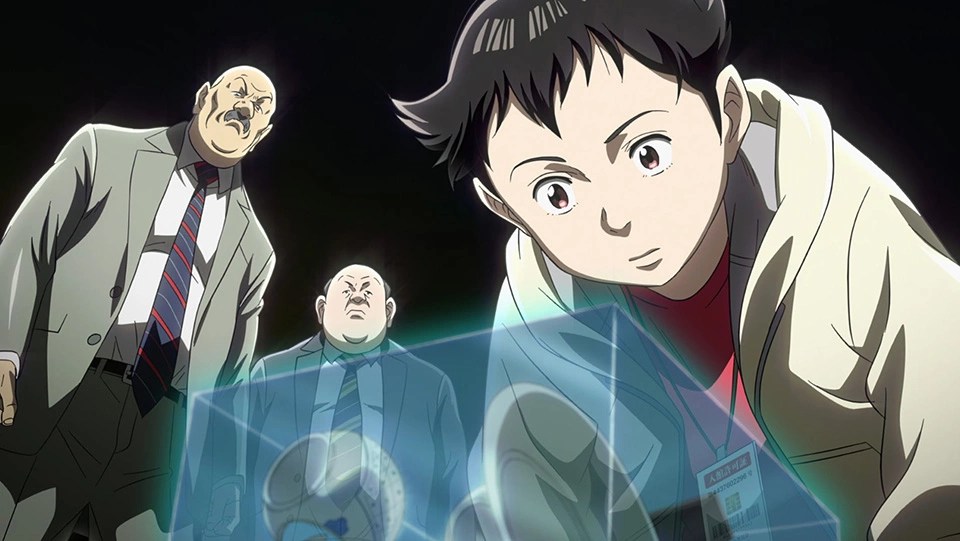
Indeed, his father not only expels him from his life but condemns him to a life of servitude. Plus, Tezuka-sensei thought it would even more “cheerful” to endow Astro Boy with human emotions and feelings. The dude was constantly bullied wherever he went and only later would he find friends and help people.
Naoki Urasawa was such a big fan ofAstro Boythat he made a manga based on it calledPluto.

The impact of Osamu Tezuka andAstro Boyon Naoki Urasawa
Within the story of Astro Boy, Osamu Tezuka wrote that the robot character was built in 2003. Hence, in 2003, to celebrate the birth year ofAstro Boy, the rights holders opened up the property and many different manga artists reimagined the story ofAstro Boyin their own style. Lots of artists were doing tributes and illustrations or short one-off manga to celebrate his birth year.
“The Greatest Robot in the World” is a very popular arc inAstro Boy, so Urasawa-sensei thought, “Isn’t anyone going to remake this? It’s a great story that needs to be developed more!” During his time, nobody had the willpower to do the task. Eventually, Urasawa-sensei’s editor told him to do it and the mangaka thought it was crazy.
“I don’t want to do that again”: Pluto is the Last Fans Will Ever See of Naoki Urasawa’s Darker Interpretations of Classic Manga After the Pain it Put Him Through
But he managed to gather his wits and write it.Plutowas serialized in Shogakukan’s seinen manga magazine Big Comic Original from September 2003 to April 2009, with its 65 chapters collected into eight tankōbon volumes.
Urasawa-sensei had so much respect for Tezuka-sensei that the sheer pressure of reimagining a part of his magnum opus was too much. So, he decided he didn’t want to take up another project like that ever again in the future.
I’m a very big fan of Tezuka’s work, so I think that sheer amount of respect really affected me as I was working on Pluto. That enormous amount of pressure that I felt both from outside and within myself began to affect my health, and that’s a big reason I don’t want to do that again.
Pluto and Monster are both available to watch on Netflix.
Anand Bhaskaran
Articles Published :134
A Dragon Ball fanatic who also loves to read and talk about Indian spirituality. An MBA finance graduate with a passion for doing everything that is unrelated to it. Anand has over 4 years of experience under his belt, having worked with leading content heads in the anime community. Currently, he’s more into Slice of Life and Romcom shows than actual Battle Shonen. But unfortunately, he’s stuck with a job writing ONLY about Battle Shonen (smh).
